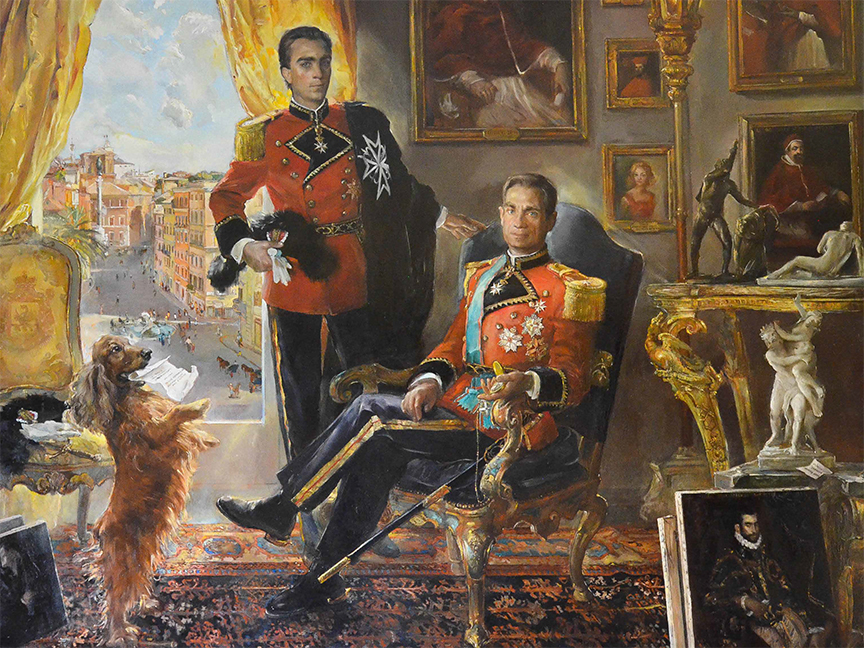

Above: prince Alessandrojacopo Boncompagni Ludovisi (left) and his father Paolo. You can view the portrait and other images from the prince’s life on the Tenuta di Fiorano website.
The Italian wine world mourns the loss of one of its brightest figures this month: prince Alessandrojacopo Boncompagni Ludovisi, who died last week after battling a short illness according to mainstream media reports. He was 53.
American wine professionals and restaurateurs knew him because of the famous wines he and his family produced just south of Rome along the Appian Way.
But in the Italian capital, where he lived on Piazza Spagna, he was widely known as the prince gallerist, a collector of modern and contemporary art, custodian of his family’s sprawling collection of Renaissance, baroque, and mannerist paintings. He regularly mounted shows by top artists. And he ran an arts and wine educational program led by leading Italian wine writer and intellectual Armando Castgano.
Some may remember a heady time in the Italian wine business, in the first decade of this century, when aged white wines from the Tenuta di Fiorano were sold for astronomical sums in New York City. In his weekly Times column, Eric Asimov featured the library releases, including his visit at the winery and farm built by Alessandrojacopo’s uncle Alberico.
At the time, one of the city’s leading wine mavens, Charles Scicolone, would openly remark that yes, the white wines were very good. But the reds, he said, were the wines that landed Fiorano among the world’s greatest. He later organized a dinner, attended by Eric and me among others, where we tasted a vertical flight of astounding Bordeaux blends.
Many years later I would host the prince at Rossoblu in Los Angeles where I was wine director. What an incredible night, tasting back into the early 80s with the prince!
He had flown to California just for our sold-out event. I asked what he planned to do before returning to Rome. I’m going to view a portrait of one of my ancestors at the Getty, he said.
It turned out to be Pope Gregory XIII, the same one that gave us the Gregorian calendar.
Sit tibi terra levis Alexander Iacobe.
Below: the estate lies adjacent to one of the most beautifully maintained stretches of the Appian Way. It can’t be seen in the photo but it stands just to the right of the road. Note the name of the crossroad: Fiornallo (after Fiorano).


 Jeremy Parzen
Leave a comment